




Travel Bidet Guide: Best Portable Options for 2026
Table of Contents
- Why a Travel Bidet Beats Squeeze Bottles and Wet Wipes
- What to Look for in the Best Travel Bidet
- Rechargeable Portable Bidet vs. Manual Squeeze Bottle
- How to Use a Travel Bidet: Step-by-Step
- Top Picks: Portable Bidets for Every Trip
- Hygiene, Drying, and Safe Storage on the Go
- Air Travel and International Considerations
- Conclusion
- Frequently Asked Questions
Last Updated: October 19, 2026
Why a Travel Bidet Beats Squeeze Bottles and Wet Wipes
A travel bidet is a compact, no-plumbing washing device that lets you rinse with clean water wherever you go. At PortaBidets, we've heard the same complaint for years: the portable options people try first are basically weak water sprayers. Squeeze bottles lose pressure the moment the bottle empties, and wet wipes leave residue, clog plumbing, and pile up in landfill. Once you use a bidet at home, going without one is hard. Some people out right refuse!
What to Look for in the Best Travel Bidet
The best travel bidet balances three things: usable pressure, enough water between refills, and easy to use.
Water Pressure and Spray Performance
Pressure is where cheap units fall apart. A manual squeeze bottle delivers strong flow at the start and a dribble at the end, because you're the pump. A rechargeable portable bidet uses a motor, so the spray stays even whether the reservoir is full or nearly empty. Look for adjustable modes rather than a single setting: the Traveler offers four pressure modes (low, medium, high, highest) plus three wash types: wash, enema, and feminine.

Water Capacity and Real-World Uses per Fill
Capacity determines how often you refill, the hidden annoyance of portable units. The Traveler carries a 1.4L reservoir, which covers multiple uses per fill for most people. Heavy water users can add the 5L Water Bag three-pack; the bags are food-grade PA/PE/PET and flatten to almost nothing when empty.

Feature |
Why It Matters |
What to Check |
|---|---|---|
Pressure modes |
Consistent clean as reservoir drains |
Multiple settings, not one |
Reservoir size |
Fewer refills per trip |
Liters per fill vs. your usage |
Mount type |
Hands-free vs. handheld control |
Microsuction track or handheld wand |
Packability |
Fits in a carry-on |
Detachable parts, flat storage |
Power |
Works away from outlets |
Rechargeable battery |
Rechargeable Portable Bidet vs. Manual Squeeze Bottle
Manual squeeze bottles win on price and nothing else. They're light, cheap, and run out of pressure exactly when you need it most.
The trade-off is charging. A rechargeable unit needs power between trips, so pack the cable and top it off before you leave. For a day car trip, a squeeze bottle might be fine. For a weekend hotel stay, the powered option earns its place in the bag.
Pressure Behavior Across a Full Reservoir
The clearest difference between the two designs is what happens as the water level drops. A squeeze bottle's pressure depends on how hard you squeeze and how much air is above the water; as it empties, you squeeze harder and the stream gets choppier. A powered unit uses a motor and pump, so the spray stays even whether the reservoir is full or nearly empty.
When you compare units, ask two questions competitors rarely answer plainly:
- Does pressure hold at low reservoir levels? A pump-driven design should; a squeeze design cannot.
- How many pressure settings are there, and are they distinct? Four modes that feel identical are marketing, not function. The Traveler's four modes (low, medium, high, highest) plus three wash types (wash, enema, feminine) are meaningfully different in use.
Battery Life and Charging Reality
Battery specs are where listings get vague, so treat any claim as a starting point. A full charge typically covers multiple days of typical use, but heavy users and long sessions drain faster. Practical rules that hold across most rechargeable models:
- Charge before you leave, not after you arrive. Hotel outlets are often occupied or oddly placed.
- Bring the cable, and a small power bank if you're remote. A dead bidet mid-trip is a dead bidet.
- Top off opportunistically. A partial charge on a travel day costs nothing and prevents surprises.
- Store at partial charge for long gaps. Fully drained batteries are harder on cells than a half charge.
If your trip is short and outlet access is uncertain, a manual bottle is the lower-risk choice. If you want consistent pressure and don't want to depend on hand strength, the powered unit is worth the charging overhead.
Grip, Ergonomics, and Who Each Design Suits
Squeeze bottles require sustained hand force and a stable grip, awkward in a small hotel bathroom or public stall. Powered units trade that force for a button press, the difference between usable and exhausting for anyone with arthritis, carpal tunnel issues, or limited mobility. The counterpoint is weight and bulk: a powered unit with a 1.4L reservoir is heavier packed than an empty bottle, and its hose and wand need accounting for.
A simple decision rule:
- day car trip, light packing, tight budget: manual squeeze bottle.
- Multi-day hotel or Airbnb stay, consistent pressure wanted: rechargeable powered unit.
- Limited grip or mobility: powered unit, full stop.
- Remote travel with unreliable power: manual bottle plus a backup, or a powered unit with a power bank.
How to Use a Travel Bidet: Step-by-Step
Using a travel bidet takes about a minute once you've done it twice. This sequence works for a mounted system like the Traveler.
- Fill the reservoir with warm or cold water and seat the cap firmly.
- Mount the track to the toilet seat using the reusable microsuction system. No tools, no plumbing, no marks left behind.
- Attach your wand by sliding it into the track, or connect the handheld wand for odd-shaped toilets and public restrooms.
- Connect the hose from pump to reservoir, then from pump to wand.
- Select your mode and wash. Start on low, adjust upward as needed.
- Remove and pack the track when you're done. It comes off clean.
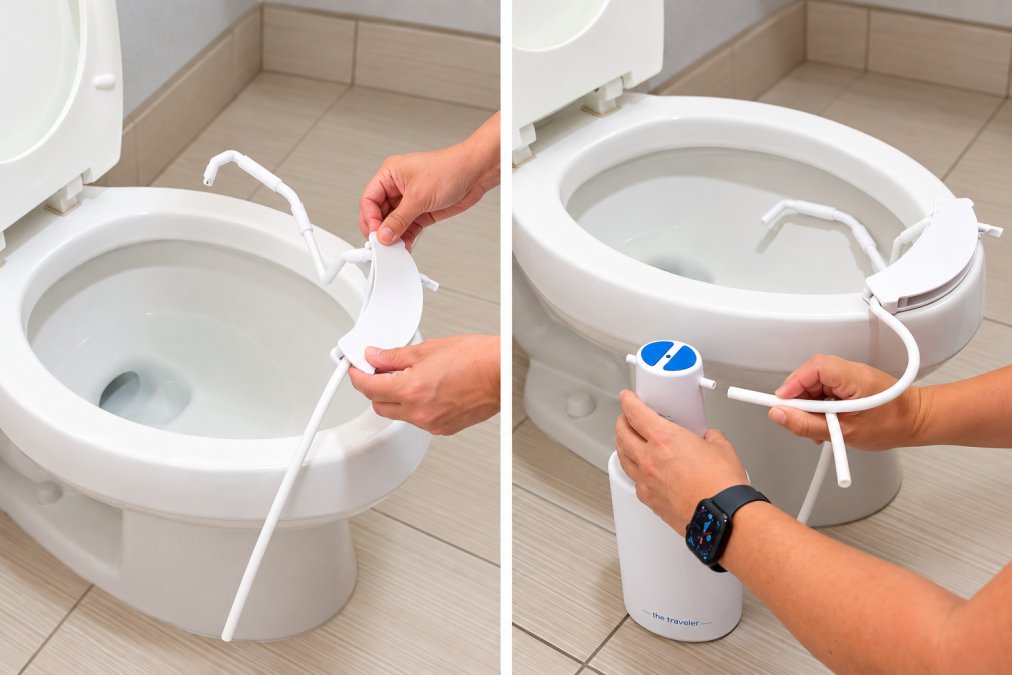
Expected result: a hands-free wash with steady pressure, no installation, and nothing left behind on the fixture.
Top Picks: Portable Bidets for Every Trip
Our top pick for most travelers is The Traveler Portable Bidet at $149.
PortaBidets Wand ($99) is the handheld option.
Traveler Toilet Mount Kit ($59) converts an existing PortaBidets Home setup into a travel system.
The Traveler Portable Bidet | Toilet-Mounted Travel Bidet →
Handheld Wand Add-On ($24.99) adds a two-piece 12.5-inch wand and 60-inch tubing to your Traveler.
5L Water Bag three-pack ($14.99) adds water for long sessions and road trips. Best for heavy water users.
Hygiene, Drying, and Safe Storage on the Go
Clean water is only half the job; drying and storage are the other half. Pat dry after washing, then let the wand air-dry before packing. Empty the reservoir fully before storing it, since standing water in a sealed bag is where odor starts. Wipe the wand tip with an alcohol wipe between uses if you're sharing a bathroom, and keep the kit in its own pouch. These habits take thirty seconds and keep the device pleasant for years.
Air Travel and International Considerations
Airport security is simpler than people expect: empty the reservoir and pack the unit in your checked bag or carry-on, since it contains no prohibited components. Empty it completely so it doesn't trigger a liquid query at screening.
International trips raise one practical question: toilet compatibility. Most hotel and Airbnb toilets accept a microsuction track, but older or unusually shaped fixtures may not, therefore we recommend the Portabidets Wand. Check the TSA's rules on carry-on liquids before you pack anything else in the same bag.
Packing and Security Screening, Step by Step
The goal at security is to make the bidet obviously empty and harmless. A repeatable routine:
- Drain and air-dry the reservoir at least a few hours before packing. Residual water is what triggers questions and, worse, leaks.
- Disconnect the hose and wand and pack them separately from the reservoir so nothing presses on a seal.
- Bag the whole kit in its own pouch. This keeps it away from clothing and makes it easy to pull out if a screener asks.
- Carry it on when you can. Checked bags get lost; a bidet you can't reach is useless. The unit has no prohibited components, so carry-on is usually fine once it's empty.
- Keep the charging cable with the kit, not buried in a different bag.
Screeners care about liquids and batteries, not the device itself. An empty reservoir and a battery small enough for carry-on rules rarely cause a second look. If you're ever unsure, the TSA liquids rule page is the authoritative source.
Water Sourcing Away from Home
Clean water is the input that makes a bidet work, and travelers most often overlook it. Hotel sink water is fine in most destinations, but if you're cautious about local water quality, use bottled or filtered water. Two practical notes:
- Don't fill from the toilet tank. It's not clean water, even when it looks clear.
- Fill before you need it. Filling at the sink right before a wash is easy; discovering the tap is dry or the sink is occupied is not.
For long sessions or road trips, the 5L Water Bag three-pack extends a session considerably; the bags are food-grade PA/PE/PET and flatten to almost nothing when empty. That's the difference between one wash per fill and a full day of use.
Toilet Compatibility Abroad
Fixture shapes vary more than most travelers expect. A microsuction track works on smooth, flat seat surfaces; older or unusually contoured toilets may not hold it reliably, and the handheld wand is the fallback because it needs no mounting. On arrival, press the track in place, give it a gentle tug, and confirm it holds before committing to a hands-free wash. If it doesn't, switch to the handheld wand.
Charging and Power Logistics
Rechargeable units need power between uses, and international travel adds outlet and voltage variables. Bring the charging cable, confirm your adapter works with the unit's input, and charge during downtime rather than waiting for a low battery. A small power bank is cheap insurance for remote stays; if you're moving between cities every day, charge at every opportunity.
Conclusion
Travel hygiene is one of those things you don't think about until it's inconvenient, and a weak squeeze bottle makes it worse. If you want the same clean you get at home, a powered, mountable system is the answer. Our customers put it plainly: it's the only portable bidet with enough pressure. Shop bidets and pack a real clean for your next trip.
Frequently Asked Questions
Are travel bidets worth it?
For frequent travelers, renters, or anyone who prefers water over dry paper, a travel bidet pays for itself quickly. It reduces reliance on toilet paper and wet wipes, which can irritate skin and clog plumbing. Models like The Traveler Portable Bidet ($149) offer four pressure modes and a 1.4L reservoir, delivering a home-like clean in hotels, Airbnbs, or RVs. If you only travel a few times a year, a manual squeeze bottle may suffice, but for regular trips, a rechargeable portable bidet is a worthwhile upgrade.
What is the best bidet for travel?
The best travel bidet balances portability, pressure, and ease of use. The Traveler Portable Bidet stands out because it mounts to most toilets with a reusable microsuction system, offers four pressure settings and three wash types, and packs into luggage. For a lighter setup, the PortaBidets Wand ($99) pairs with a pump and reservoir for handheld control. Consider how you travel: hotel-hoppers benefit from a mountable unit, while backpackers may prefer a compact squeeze bottle.
How do you use a portable travel bidet?
Fill the reservoir with warm or cold water, attach the wand or nozzle, and position yourself on the toilet. Turn on the pump (or squeeze the bottle) to start the spray, adjusting pressure and angle as needed. Pat dry with toilet paper or a travel towel. After use, empty any remaining water, wipe the nozzle with a disinfecting wipe, and let all parts air-dry before packing. For a toilet-mounted model like The Traveler, secure the track to the seat first, then connect the hose and reservoir.
Can you take a travel bidet on a plane?
Yes, travel bidets are allowed in both carry-on and checked luggage. Rechargeable models must follow TSA rules for lithium batteries: batteries under 100 watt-hours are generally permitted in carry-on, but check with your airline. Empty the water reservoir completely before packing to prevent leaks, and store the bidet in a sealed plastic bag. Manual squeeze bottles are even simpler since they contain no electronics. Always declare any unusual items if asked by security.


