




Portable Bidet for Travel 2026: Top Picks & Guide
Table of Contents
- What to Look for in a Portable Bidet for Travel in 2026
- Best Electric Travel Bidet Features That Matter
- How to Use a Portable Bidet Anywhere
- TSA Rules and Air Travel: What You Can Carry On
- International Voltage, Plug Adapters, and Charging Abroad
- Maintenance, Mold Prevention, and Long-Term Care
- Eco-Friendly Impact: Reducing Toilet Paper and Wet Wipes
- Frequently Asked Questions
Last Updated: September 17, 2026
What to Look for in a Portable Bidet for Travel in 2026
A portable bidet for travel is a compact, refillable device that delivers a directed water spray without plumbing. This guide from PortaBidets breaks down what separates a device that actually cleans from one that just mists. Rechargeable pumps, USB-C charging, and sealed nozzles now define the better options, while squeeze bottles still dominate the budget shelf.
Electric Pump vs Manual Squeeze Bottle
The single biggest decision is pump type. Electric models use a rechargeable pump for consistent pressure; manual squeeze bottles rely on hand strength alone.
Water Capacity, Pressure, and Nozzle Design
Reservoir capacity, spray pressure, and nozzle angle decide how well a portable bidet cleans. Look for a reservoir that holds enough for one full use, an adjustable wand, and an angled nozzle.
- Reservoir capacity: enough for a complete clean without a refill
- Water pressure: adjustable, not fixed at one weak setting
- Nozzle design: angled tip and multiple spray modes
- Ergonomic grip: matters most for anyone with arthritis or reduced mobility
Best Electric Travel Bidet Features That Matter
Electric travel bidets earn their price through three features: battery life, charging standard, and water resistance.
Battery Life and USB-C Charging
USB-C charging is the default standard and should be non-negotiable in 2026: one cable covers your phone, laptop, and bidet.
How to Use a Portable Bidet Anywhere
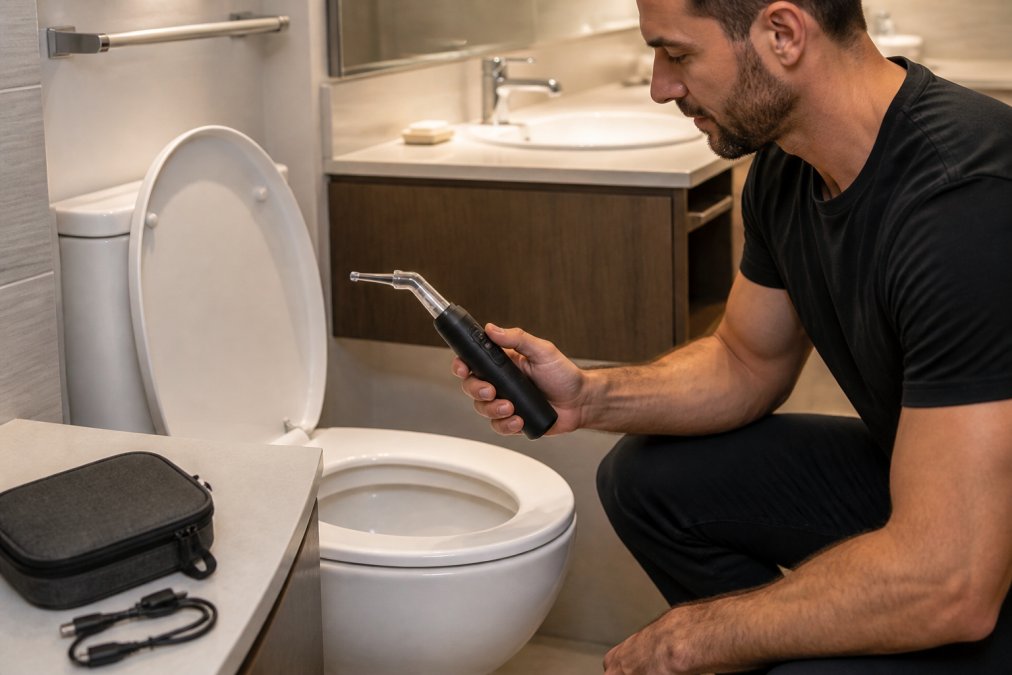
Using a portable bidet takes about the same time as toilet paper once you've done it twice: fill, position, spray, rinse the nozzle.
In a Hotel or Airbnb
Fill the reservoir from the sink tap, position the adjustable wand, and spray. No mounting, tools, or plumbing.
In a Public Restroom or While Camping
A public restroom works the same way, but carry a small bottle of water if the tap is awkward to reach. For backcountry and RV travel, fill from a jug before you head out.
- Carry a small refill bottle for public restrooms
- Use the lowest spray mode in tight stalls
- Wipe and cap the nozzle after every use
TSA Rules and Air Travel: What You Can Carry On
A portable bidet travels in carry-on without special handling as long as it's empty. The TSA 3-1-1 liquids rule applies to liquids, gels, and aerosols in containers of 3.4 ounces (100 mL) or less, all of which must fit in a single quart-sized bag, so the reservoir is the only part of the device that matters at the checkpoint.
Why an Empty Reservoir Usually Clears Screening
TSA screens for liquids in containers, not devices that can hold liquid. A bidet with a drained reservoir, capped nozzle, and no standing water reads on the X-ray as a plastic or silicone object, the same category as an empty water bottle, which TSA permits in carry-on.
The practical sequence that avoids a bag search:
- Drain the reservoir completely the night before you fly, not at the airport.
- Run one dry spray cycle to push residual water out of the pump and tubing.
- Leave the cap off overnight so the interior air-dries.
- Cap it, then pack it in a sealed pouch or zip-top bag.
- Keep it accessible in your quart bag if you want a fast resolution at the lane.
What Triggers a Secondary Screening
A bidet rarely causes a problem on its own. The triggers are almost always about water:
- Visible liquid in the reservoir. Even a small amount can prompt a bag check, because the officer can't verify the volume without opening it.
- A damp device or pouch. Residual moisture reads as a liquid signature on the X-ray and invites a hand inspection.
- A full reservoir packed in a checked bag. Checked bags aren't bound by 3-1-1, but a full reservoir can leak under cabin pressure changes and ruin everything around it.
- A device with a built-in heater or large battery. Lithium batteries have their own carry-on rules, and a heated bidet may draw extra attention.
Carry-On vs. Checked Bag
Carry-on is the better choice: you keep the device if a checked bag is delayed, an empty bidet clears the checkpoint quickly, and lithium batteries in rechargeable models face carry-on restrictions anyway.
International Flights and Connecting Itineraries
The 3-1-1 rule applies to flights departing the United States. On international itineraries the same logic generally holds, most security regimes screen for liquids in containers, but volume limits and bag requirements vary by country. If you're connecting through a foreign hub, drain the reservoir before every leg; a device empty at home can pick up condensation in a cargo hold or humid hotel room.
The Bottom Line for Air Travelers
An empty portable bidet is a non-issue at the checkpoint; a full one is a liquid, leak risk, and mold risk at once. Drain it, dry it, cap it loose, and pack it in a sealed pouch, that habit covers TSA, connecting flights, and the weeks between trips.
International Voltage, Plug Adapters, and Charging Abroad
Charging abroad is where most travel electronics fail, and bidets are no exception. The failure is usually a mismatch between what the charger expects and what the wall socket delivers: voltage and plug shape.
Voltage: What the Numbers on the Charger Mean
Mains voltage varies by region: U.S. outlets deliver roughly 120 volts at 60 Hz, while many other regions run 220-240 volts at 50 Hz (Electricity 101). A charger rated only for 120 V plugged into a 230 V outlet can overheat or fail; a dual-voltage charger handles both.
- "100-240V, 50/60 Hz", dual voltage. This is what you want. It works on either system with only a plug adapter.
- "120V only", single voltage. Do not plug it into a 220-240 V outlet, even with an adapter. An adapter changes the plug shape, not the voltage.
- "220-240V only", the reverse problem. It won't work on a standard U.S. outlet without a step-up converter.
USB-C Charging Sidesteps Most of the Problem
If your bidet charges over USB-C, the wall is no longer your concern. USB power is standardized: a USB-C charger accepting 100-240 V input delivers the correct output regardless of the outlet. You need a plug adapter, and that's it.
Plug Types: What to Expect Where
Plug shape varies by region with no universal standard. The practical approach is a compact universal adapter with sliding or stacked pins covering the common types, flat two- and three-pin (North America, Japan), round two-pin (Europe), and three-pin rectangular (UK, parts of Asia).
Check two things before you leave:
- Does the adapter accept your charger's plug? Most universal adapters do, but confirm the pin configuration.
- Does the adapter have a USB port? Many modern adapters include one, which lets you skip the wall charger entirely for USB-C devices.
Power Banks as a Backup
A power bank is the most reliable charging backup because it doesn't care about outlet voltage or plug shape. Charge the bank at home, then recharge the bidet from it anywhere.
Two practical notes:
- Capacity matters more than port count. A bidet draws a small amount per charge, so a mid-capacity bank can cover several recharges. Check the bank's rated output against the bidet's input requirement.
- Airline rules apply to power banks too. Lithium batteries are subject to carry-on restrictions, so keep the bank in your cabin bag, not your checked luggage.
A Pre-Trip Charging Checklist
- Confirm the charger's input rating is 100-240 V, 50/60 Hz.
- If it's USB-C, pack one dual-voltage wall charger and one universal plug adapter.
- If it's a dedicated wall charger, verify dual voltage before you rely on it.
- Charge the bidet and the power bank the night before you fly.
- Pack the cable and adapter together so neither goes missing in transit.
The Bottom Line for Charging Abroad
USB-C has made international charging a solved problem for most travelers: one dual-voltage charger, one universal adapter, one cable. If your bidet uses a dedicated wall charger, read the input rating before packing, and treat a power bank as your safety net.
Maintenance, Mold Prevention, and Long-Term Care
Long-term care comes down to one habit: never store the device wet. Empty the reservoir, rinse with clean water, and air-dry every part fully before capping.
- Empty and air-dry after every trip
- Rinse the nozzle and reservoir with clean water monthly
- Store with the cap loose, not sealed
- Replace any part that stays damp or discolored
Eco-Friendly Impact: Reducing Toilet Paper and Wet Wipes
Switching to a bidet cuts two waste streams at once: toilet paper and wet wipes. Wet wipes are a particular problem because many don't break down and contribute to sewer blockages.
Frequently Asked Questions
Are travel bidets TSA approved?
Yes, empty portable bidets pass through TSA security without issue. The 3-1-1 liquids rule applies to any water in the reservoir, so drain it before you fly and refill at your destination. Rechargeable electric models with lithium batteries must go in carry-on luggage, not checked bags, per FAA rules. Manual squeeze bottles have no battery restrictions. Either way, pack the unit dry and keep it accessible for screening.
Do portable bidets require batteries or charging?
It depends on the type. Manual squeeze bottles need no power at all, but they deliver weak water pressure. Electric models use a rechargeable battery, typically charged by USB-C, and produce a steady spray closer to a home bidet. Battery life varies by model and spray mode, so check the rated runtime before a long trip. Bring a USB-C cable and a power bank as backup.
How do you use a portable bidet in a public restroom?
Fill the reservoir beforehand or at the sink, then carry it into the stall. Position the nozzle at a downward angle behind you, aim forward, and spray. Most electric models have adjustable spray modes and pressure settings, so start on the lowest setting. Wipe dry with a small amount of toilet paper, then empty and rinse the reservoir before storing it in a leak-proof bag.
What is a good portable bidet for travel?
A good portable bidet for travel balances pressure, portability, and hygiene. Look for a rechargeable electric pump rather than a manual squeeze bottle, an IPX waterproof rating, USB-C charging, adjustable spray modes, and a compact, leak-proof design that fits in a carry-on. An ergonomic grip and adjustable wand help with comfort and control. PortaBidets offers a no-plumbing, mountable option built for hotels, Airbnbs, and RVs.


