




Best Portable Bidet for Post-Surgery Recovery at Home
Table of Contents
- Why a Portable Bidet Helps During Post-Surgery Recovery at Home
- Quick Comparison: Best Portable Bidets for Recovery
- 1. The Traveler Portable Bidet: Best Overall for Recovery at Home
- 2. PortaBidets Home: Best No-Plumbing Bidet After Surgery
- 3. PortaBidets Wand: Best Handheld Bidet for Limited Mobility
- Why the Portable Bidet for Elderly Users Is Easier to Operate
- How to Clean Yourself After Using a Bidet During Recovery
- Safety, Hygiene, and When a Portable Bidet May Not Be Appropriate
- Frequently Asked Questions
Last Updated: October 19, 2026
Why a Portable Bidet Helps During Post-Surgery Recovery at Home
A portable bidet is a no-plumbing device that sprays water for personal hygiene without permanent installation.
Here at PortaBidets, we built our whole product line around this problem.
Below, we break down the best portable bidet for post-surgery recovery at home, compare our three options, and explain how to clean yourself safely.
One thing before we start: this is product guidance, not medical advice. Your surgeon's instructions always win.
Quick Comparison: Best Portable Bidets for Recovery
Here is how our three options stack up for at-home recovery. All three work without plumbing or tools, and all three run on the same rechargeable pump system.
Product |
Price |
Water Capacity |
Best For |
Standout Feature |
|---|---|---|---|---|
$149.00 |
1.4L reservoir |
Best overall for recovery at home |
Temporary bidet attachment, hands free |
|
PortaBidets Home |
$104.00 |
Shared Traveler reservoir |
No-plumbing bidet after surgery |
Bidet seat attachment, easy install with screwdriver |
PortaBidets Wand |
$99.00 |
Shared pump and reservoir |
Caregiver help, Getting to bathroom/toilet is hard |
Handheld control, angled reach |
1. The Traveler Portable Bidet: Best Overall for Recovery at Home
Our top pick for recovery is The Traveler, the most capable unit we make. Its features map directly onto what recovery demands: control, capacity, and no installation.

The Traveler mounts to the toilet and stays there for your entire recovery.
The 1.4L reservoir means fewer refills, which matters when bending to refill a small bottle is the exact motion you are trying to avoid.
Pros and Cons
Pros:
- Four pressure settings let you dial down to a gentle spray when tissue is sensitive
- 1.4L reservoir reduces refill trips
- Mounts to the toilet, so no handheld squeezing or aiming
Cons:
- At $149.00, it costs more than a basic squeeze bottle
- The reservoir takes up floor space beside the toilet
2. PortaBidets Home: Best No-Plumbing Bidet After Surgery
If you want something that feels like a permanent fixture without touching a pipe, PortaBidets Home pairs the same Traveler pump and reservoir with a bidet seat attachment.

That gives you a consistent clean from a seat-mounted unit, easier on the body than holding and aiming a handheld device.
It costs $104.00, which makes it our value pick for at-home recovery. You can add the Handheld Wand Add-On later if you want extra reach for hard-to-angle positions.
Pros and Cons
Pros:
- Seat attachment means no aiming or holding
- No plumbing or water line access required
- Cheaper than The Traveler at $104.00
Cons:
- Reservoir sits separately from the seat
- Fewer wash modes than The Traveler
- It does require installation to your toilet seat with a screw driver.
3. PortaBidets Wand: Best Handheld Bidet for Limited Mobility
The Portabidet Wand is our answer if you might need help from a caregiver. It can be used outside of a restroom, off a toilet if necessary.
Handheld control is the point: you direct the spray exactly where you need it, at the angle that works for your body that day.
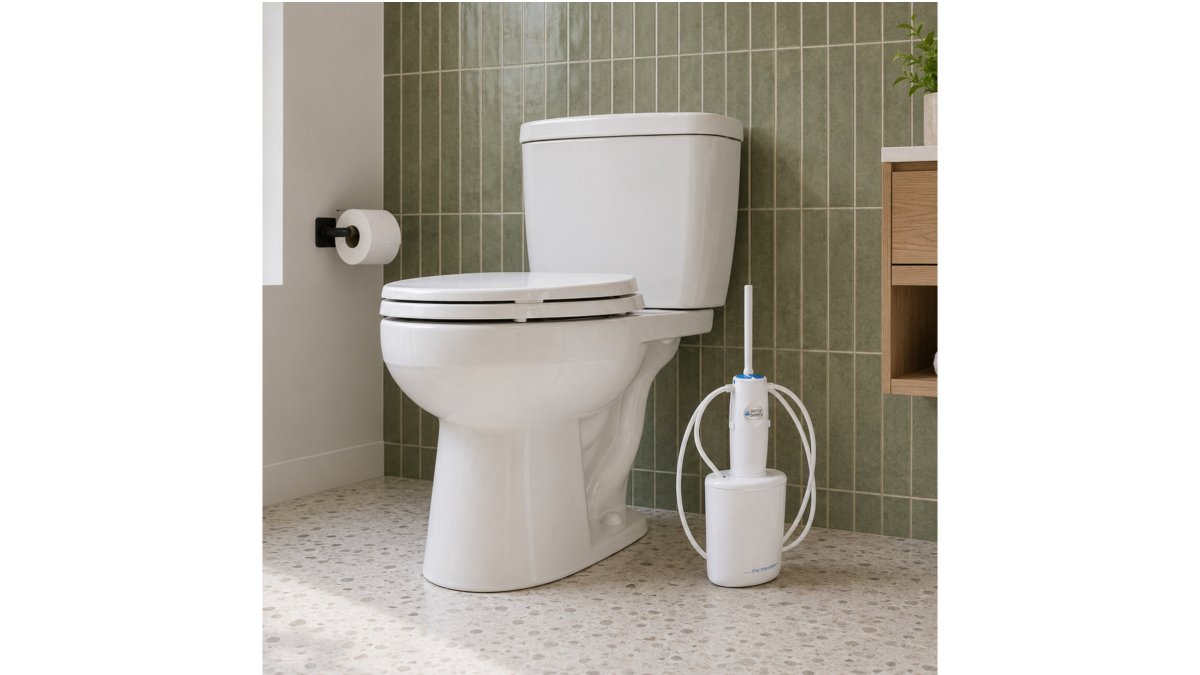
At $99.00, it is our most affordable complete handheld option.

Pros and Cons
Pros:
- No squeezing
- Angled wand reaches where you point it
- Works at home or away
Cons:
- Requires you to hold and aim, which some users find tiring
- Tubing needs to be managed
Why the Portable Bidet for Elderly Users Is Easier to Operate
For older adults and anyone recovering with limited mobility, the hardest parts of post-surgery hygiene are reaching, twisting, gripping, and standing back up. A portable bidet helps only if it removes those movements rather than adding new ones. The right question is not "portable versus installed" but "which operating motion can this person repeat several times a day without tiring or risking a fall."
The four operating motions that matter
Most portable bidets ask the user to do some combination of these. Compare any device against your own limits, not a spec sheet.
PortaBidets Wand – Handheld Bidet →
- Reach: Can you reach the controls, nozzle, and reservoir without bending or twisting? A seat-mounted unit with controls at hip height is easier than a handheld wand aimed behind you.
- Grip: Does the device require squeezing, pumping, or holding a trigger? Manual squeeze bottles demand repeated hand pressure and deliver uneven flow as your hand tires. A rechargeable pump that runs on a button press removes that effort entirely.
- Aim: Does the spray go where you point it without you having to see or feel the nozzle? Fixed seat attachments reduce aiming decisions; handheld wands give control but require steadier hand positioning.
Matching the device to the limitation
- Shoulder, wrist, or grip limitations: A button-operated pump with a seat-mounted attachment is usually less tiring than a handheld wand, because there is no holding and aiming. If a caregiver will assist, a handheld wand can be easier for the helper to direct.
- Hip, knee, or balance limitations: A unit that stays mounted to the toilet means fewer objects to pick up and put down. Keep the reservoir at counter height so refilling does not require bending.
- Abdominal or pelvic restrictions: Avoid setups that require twisting to reach a reservoir behind the toilet. Place the reservoir to the side you can reach comfortably, or have a caregiver handle refills.
Caregiver assistance
If a family member or home health aide helps with hygiene, the device should make their job easier too. A handheld wand with tubing lets a caregiver direct the spray without the user holding anything; a seat-mounted unit lets the user stay seated while the caregiver manages pressure and refills. Agree on a routine before the first use.
At-home setup and bathroom ergonomics
A portable bidet is often easier than installing an attachment during a temporary recovery because it requires no plumbing, no tools, and no permanent change to a rental or shared bathroom. But "no installation" does not mean "no setup." Plan for: Establishing a dedicated space for hygiene is a vital component of supporting surgical recovery, especially when navigating the complex needs that arise after brain surgery.
- Storage within reach: Keep the device and a clean towel where you can get them while seated or standing safely, not in a cabinet across the room.
- Refill access: Place the reservoir at counter height or on a stable stool so refilling does not require bending or lifting a full container from the floor.
- Toilet-side positioning: Route tubing so it does not cross the floor where you step, and keep the floor dry.
A recovery-focused way to compare options
When you compare portable bidets for recovery rather than travel, rank them on recovery-relevant measures: one-handed operation, usable capacity before a refill, low-end pressure control, reach and aim without twisting, stability on the toilet, and effort to clean the reservoir and nozzle. Travel convenience matters less when the device stays in one bathroom for a few weeks. Ask your care team or an occupational therapist if you are unsure which operating motion is safe for you.
How to Clean Yourself After Using a Bidet During Recovery
Cleaning yourself after using a bidet comes down to five steps: adjust pressure low, spray from front to back, pat dry, check the area is dry, and wash your hands.
- Set the pressure to low before you start. Increase only if you need more.
- Spray from front to back, never the reverse, to avoid moving bacteria toward the urethra.
- Pat dry with a clean towel or let air dry. Do not rub, especially near an incision.
- Check that the area is fully dry before dressing. Moisture around a wound is a problem.
- Wash your hands, then clean the nozzle per the manufacturer's instructions.
Safety, Hygiene, and When a Portable Bidet May Not Be Appropriate
A portable bidet is a hygiene tool, not a medical device, and it is not appropriate for every recovery. Treat your care team's instructions as the controlling rule and use the guidance below only to prepare better questions and a better bathroom setup.
A practical at-home hygiene routine
Hygiene failures with portable bidets usually come from the reservoir and nozzle, not the spray itself. A simple routine:
- Before each use: Inspect the nozzle. Wipe it with a clean cloth or follow the manufacturer's cleaning step. Do not touch the nozzle opening with your hands.
- After each use: Run a short rinse through the nozzle to clear residue, then let it air dry fully with the cap or cover off if the design allows.
- Daily: Empty and rinse the reservoir, and let it dry completely. Do not top off a partially used reservoir day after day; standing water is where biofilm starts.
- Weekly, or per manufacturer: Deep clean the reservoir and nozzle using the method the manufacturer specifies. Do not substitute household cleaners that are not approved for the materials.
- Storage: Store the device dry, covered, and away from the toilet bowl splash zone. A bathroom cabinet or a lidded bin works better than an open shelf next to the toilet.
According to CDC guidance on wound care and hygiene, keeping a healing wound clean and dry and practicing good hand hygiene are central to preventing infection at home. That is the principle behind short sprays, front-to-back direction, thorough drying, and clean equipment.
Bathroom setup for safer use
A device only helps if you can reach it safely. Keep the reservoir within easy reach of the toilet, clear the floor of rugs and cords that can trip you, and keep a clean towel within arm's reach so you are not standing and searching while wet. If standing and turning is difficult, a toilet-side stool or grab bar can make the routine safer.
When a portable bidet may not be the right call
For some recoveries, a different approach is safer: a hospital-provided peri bottle, a caregiver-assisted cleansing routine, or a prescribed wound-care protocol. A portable bidet is a convenience and a hygiene aid, not a substitute for clinical wound care, and it should not be used to clean a wound unless your care team has told you to do so.
Frequently Asked Questions
Can you use a portable bidet after surgery?
Yes, in most cases a portable bidet is a practical way to stay clean after surgery because it reduces the bending, reaching, and wiping that can pull on incisions. A model with adjustable pressure settings lets you start on the lowest flow and increase only as comfort allows. Check with your surgeon first, especially if you have fresh stitches, a catheter, or a wound near the area, since they may give you specific instructions on water temperature and cleaning.
What features should you look for in a bidet during recovery?
Prioritize adjustable water pressure with a genuinely low setting, an angled nozzle that reaches without you shifting position, and a reservoir large enough to avoid constant refills. One-handed operation matters if reaching is painful, and a leak-proof cap keeps things tidy if you move the unit between rooms. A toilet-mounted design like the Traveler ($149) stays put for the whole recovery period, while a handheld wand ($99) gives more aim control.
Is a handheld or squeeze-bottle bidet easier to use after surgery?
A handheld wand is generally easier than a squeeze bottle because it does not require repeated hand squeezing, which is tough on weak grip or sore arms. The PortaBidets Wand uses a pump and reservoir system, so the water flows at consistent pressure without manual effort. Squeeze bottles are cheaper and lighter, but the pressure drops as the bottle empties and the grip demand can be a real obstacle during early recovery.
How do you clean and store a portable bidet between uses?
Empty the reservoir after each use, rinse it with warm water, and let it air dry fully before reassembling so no moisture sits in the tubing. Wipe the nozzle with a mild soap solution or follow the manufacturer's cleaning instructions, and avoid harsh bleach on plastic parts. Store the unit dry and assembled loosely, and if you are sharing a bathroom during recovery, keep it in a clean bag or basket rather than on the floor.
Can a portable bidet help if bending or reaching is difficult?
It can. The main advantage is that you clean with a directed spray instead of twisting to wipe, which reduces strain on the abdomen, back, and hips. A toilet-mounted model needs no holding at all, and a handheld wand with a long hose lets you aim while seated upright. Pair it with a small step stool and keep supplies within arm's reach so you are not standing up and down mid-clean.
Recovering at home is hard enough without fighting a squeeze bottle every time you use the bathroom. If you want a real bidet experience with no plumbing and no installation, PortaBidets has three recovery-friendly options: The Traveler with four pressure modes and a 1.4L reservoir, PortaBidets Home with a no-plumbing seat attachment, and the Wand for one-handed handheld control. Get started with PortaBidets and make post-surgery hygiene one less thing to worry about.


