




Is a Travel Bidet Worth It? A 2026 Guide
Table of Contents
- What Is a Travel Bidet and How Does It Work?
- How to Use a Portable Bidet (Step-by-Step)
- Rechargeable vs Manual Travel Bidet: Which One Wins?
- Benefits of Using a Bidet While Traveling
- TSA Rules and Airline Security for Travel Bidets
- Long-Term Durability and Mold Prevention
- Pricing Breakdown: What You Actually Pay
- Conclusion: Is a Travel Bidet Worth It for You?
- Frequently Asked Questions
Last Updated: October 1, 2026
What Is a Travel Bidet and How Does It Work?
A travel bidet is a portable cleansing device that delivers a directed stream of water for personal hygiene without permanent plumbing. Most models are either manual squeeze bottles you fill and press by hand, or rechargeable units with a battery-powered pump that pushes water through a nozzle at consistent pressure.
The mechanics are simple: fill a reservoir, position the nozzle, activate the flow. Manual models rely on hand strength for pressure; rechargeable models use an electric pump for steadier output and far less grip effort.
Nozzle design matters more than most buyers realize. An angled nozzle reaches the target area without contortion; a straight one forces you to shift your body. Reservoir capacity determines uses per refill, and pressure determines whether the clean feels thorough or merely wet.
At PortaBidets, we built our system around a rechargeable pump and a mountable design because squeeze bottles top out at low pressure. The Traveler, for example, pairs a 1.4L reservoir with four pressure modes and three wash types, and it mounts to the toilet rather than requiring you to hold it the whole time.

How to Use a Portable Bidet (Step-by-Step)
Using a portable bidet takes about two minutes once you've done it twice. This sequence works for both manual and rechargeable models, though rechargeable units remove the squeezing step.
- Fill the reservoir with warm or cold water. Warm is more comfortable; cold is fine and simpler.
- Mount or position the device. Toilet-mounted systems attach to the seat; handheld wands you aim yourself.
- Adjust the nozzle angle before you start the flow, not during. An angled nozzle reaches the target area without contortion; a straight nozzle forces you to shift your body.
- Turn on the pump or squeeze the bottle. Start at the lowest pressure setting.
- Aim from front to back. This reduces the risk of transferring bacteria.
- Increase pressure only if the first pass felt incomplete.
- Pat dry with a small amount of toilet paper or a dedicated travel towel.
- Empty and rinse the reservoir before packing it away.
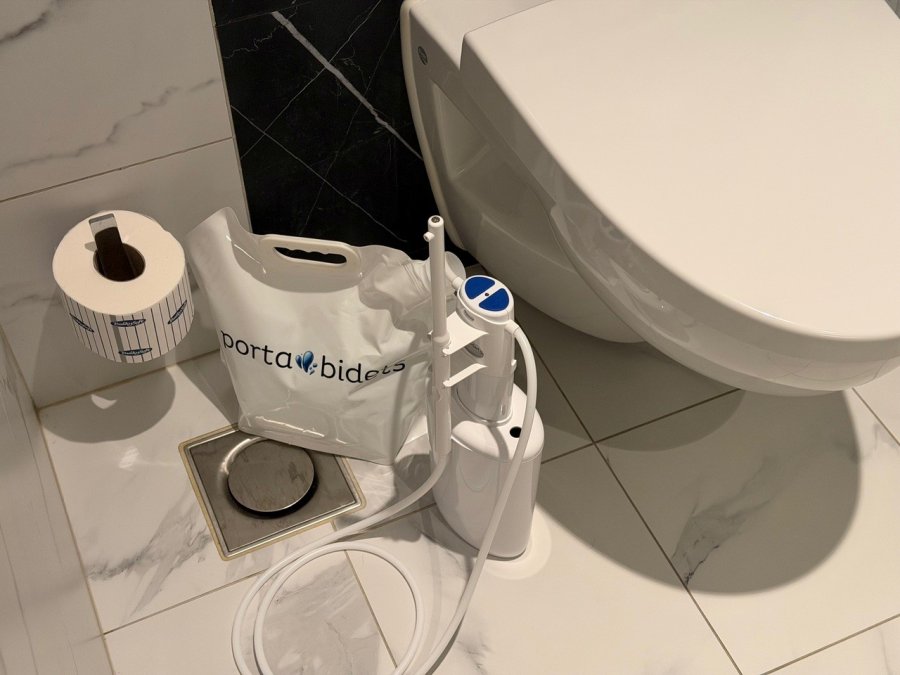
Refill Logistics in Public Spaces
Public restrooms are where most portable bidet plans fall apart. You need a water source, and sink faucets vary wildly in height and clearance.
A collapsible travel cup solves most of this: fill it at the sink, pour it into your reservoir, done in under a minute. If the faucet is too low for a bottle, the cup still works. Some travelers carry a small funnel for the same reason.
The bigger issue is discretion: filling a reservoir at a busy sink draws looks. A 1.4L reservoir like the Traveler's covers a full day of typical use, so you often refill in your hotel room and never touch a public sink. That's the practical argument for larger capacity over ultra-compact bottles.
Nozzle Angle and Body Positioning
The biggest difference between a clean that feels thorough and one that feels merely wet is nozzle angle. Most users point the nozzle straight up and lean forward to compensate, straining the lower back and making the stream harder to control.
Instead, tilt the nozzle slightly forward before starting the flow, then adjust your seat position rather than the device. On a toilet-mounted unit, sit fully back against the seat so the nozzle sits at the correct angle without hovering. On a handheld wand, hold the handle at roughly 45 degrees and let the stream do the work rather than pressing the nozzle against the body.
If your model has multiple wash types, use the widest spray for the initial pass and the narrowest for the finish. The wide spray covers more surface area with less pressure, which is gentler on sensitive skin, while the narrow spray concentrates the stream for a final rinse.
What to Do When There's No Water Source
Camping, road trips, and some international restrooms leave you without a sink. Fill the reservoir before leaving your hotel or campsite and treat it like any other water supply. A 1.4L reservoir covers a full day of typical use, so refills only become urgent on multi-day trips without plumbing access.
If you're caught without water, a small bottle of drinking water poured into the reservoir works fine. Avoid using water from streams or standing sources unless you've treated it, since the nozzle delivers water directly to sensitive areas.
Rechargeable vs Manual Travel Bidet: Which One Wins?
Rechargeable wins for anyone who wants a real clean; manual wins only on price and packability.
Feature |
Rechargeable |
Manual (Squeeze Bottle) |
|---|---|---|
Water pressure |
Consistent, adjustable |
Depends on hand strength |
Effort required |
Press a button |
Squeeze continuously |
Weight |
Heavier |
Very light |
Charging needed |
Yes |
No |
Best for |
Daily use, limited mobility |
Ultralight backpacking |
Price range |
Higher upfront |
Lower upfront |
Manual squeeze bottles are cheap and never run out of battery, but they're weak and pressure drops as the bottle empties. Fine for a quick freshen-up on a hike; it gets old fast on a two-week hotel stay.
Rechargeable models hold steady pressure from full to nearly empty. That consistency is the entire point.
Benefits of Using a Bidet While Traveling
The core benefit is simple: you maintain your normal hygiene routine instead of downgrading it for the trip. Anyone who uses a bidet at home knows how much they miss it after three days of hotel toilet paper.
Comparison with Wet Wipes
Wet wipes look like the easier answer, which is why so many travelers default to them. The problem is disposal: wipes don't break down like toilet paper, and flushing them causes blockages in building plumbing and municipal systems (the EPA). Many hotels and rental hosts explicitly ask guests not to flush them.
Plumbing Safety and Toilet Paper Reduction
One rarely quantified benefit is toilet paper reduction. A typical person uses 8 to 12 sheets per visit with dry wiping; a bidet rinse plus one pat-dry sheet cuts that to one or two. Over a two-week trip, that's a meaningful drop in what you buy, carry, and flush.
TSA Rules and Airline Security for Travel Bidets
Portable bidets pass through security without special handling in most cases. TSA's liquid rules apply to what's in your reservoir, not the device, so empty it before packing.
Long-Term Durability and Mold Prevention
Mold is the failure mode nobody warns you about, and it kills portable bidets faster than mechanical wear. Water left in a reservoir, hose, or nozzle grows biofilm within days in warm conditions.
Drying your bidet fully after every trip is the single highest-impact habit for longevity. Mold and biofilm, not mechanical failure, are what send most portable bidets to the trash.
Pricing Breakdown: What You Actually Pay
Portable bidets span a wide price range, and the gap between cheap and good is wider than in most travel gear categories. Here's what the money buys.
Option |
Price |
What You Get |
|---|---|---|
$99.00 |
Handheld, no plumbing, pairs with pump and reservoir |
|
The Traveler |
$149.00 |
Toilet-mounted, 1.4L reservoir, four pressure modes |
Handheld Wand Add-On |
$24.99 |
Adds handheld flexibility to an existing Traveler |
Traveler Toilet Mount Kit |
$59.00 |
Converts a home setup into a travel system |
Conclusion: Is a Travel Bidet Worth It for You?
A travel bidet is worth it if you use one at home and travel more than a few times a year. If you've never used a bidet, the value proposition is weaker, though the hygiene and toilet-paper savings still apply.

Frequently Asked Questions
Do portable bidets actually work for thorough cleaning?
Yes, when they deliver adequate water pressure. Manual squeeze bottles often produce weak spray, but rechargeable models with a pump and reservoir maintain consistent pressure. The PortaBidets Traveler offers four pressure modes and three wash types, using a 1.4L reservoir. This gives a hands-free clean similar to a home bidet, not just a light rinse. The key is choosing a model with a powered pump rather than relying on hand strength.
Are travel bidets TSA-compliant for carry-on luggage?
Empty travel bidets are generally allowed in carry-on bags because they are not liquids. The reservoir must be completely drained before security. If any water remains, it falls under the 3.4 oz (100 ml) liquid rule and should be packed in a clear quart bag. Rechargeable batteries must also meet airline watt-hour limits, typically under 100 Wh. Always check your specific airline's rules before flying.
How do rechargeable travel bidets compare to manual squeeze bottles?
Rechargeable models use a battery-operated pump to create steady water pressure, while manual squeeze bottles rely on hand strength and often produce inconsistent flow. For elderly users or anyone with limited grip, a rechargeable option like the PortaBidets Wand removes the need to squeeze hard. Rechargeable units also hold more water, with reservoirs up to 1.4L, reducing refills during use. The trade-off is charging time and higher upfront cost.
Do I still need to use toilet paper after using a bidet?
Most users need far less toilet paper, but a small amount for drying is common. A bidet cleans with water, which reduces irritation and toilet paper consumption. Some people prefer a dedicated towel or let air dry. If you use toilet paper, a few squares to pat dry is enough. This habit also helps prevent clogged toilets in older plumbing, especially in hotels and rentals.


