




Bidet Without Plumbing: No-Install Setup Guide
Table of Contents
- Bidet Without Plumbing: What Actually Counts as No-Install
- Types of Bidet Without Plumbing You Can Set Up Today
- How to Use a Portable Bidet: Step-by-Step Setup
- Portable Bidet Water Capacity, Battery Life, and Spray Strength
- Bidet for Renters: Lease-Safe Setup and Damage-Free Removal
- Common Mistakes and Maintenance for No-Plumbing Bidets
- Conclusion
- Frequently Asked Questions
Last Updated: October 5, 2026
Bidet Without Plumbing: What Actually Counts as No-Install
A bidet without plumbing is a cleaning device that gives you a bidet-style wash without connecting to your toilet's water line. You fill a reservoir, charge a battery, or both. No plumber, no tools, no drilling into your bathroom.
That definition matters more than it sounds. Half the products sold as "no-plumbing bidets" still hook up to the tank with a T-adapter and a flexible hose. That's an attachment, not a plumbing-free unit.
We're PortaBidets, and we built our whole product line around the difference. Squeeze bottles and tank adapters each solve half the problem. Neither gives you real pressure without touching the plumbing.
So here's the honest split before you buy anything.
Truly Plumbing-Free vs. Attachments That Connect to a Water Line
Truly plumbing-free products carry their own water. You fill a reservoir, and the device pulls from that supply. Nothing touches your toilet's tank, valve, or supply line.
Toilet attachments work differently. They tap the water line behind your toilet using a T-adapter and a hose. Installation usually takes 15 to 30 minutes and a wrench. Renters often can't do it. Neither can anyone in a dorm, an RV, or a hotel room.
The EPA's WaterSense program guidance is worth a look if you care about water use, since both types typically use far less water than a full flush.
Types of Bidet Without Plumbing You Can Set Up Today
Two designs cover almost every no-install option: handheld reservoirs and pump-driven toilet-mounted units. Both skip the water line entirely.
Handheld Portable Bidet With a Refillable Reservoir
A handheld portable bidet is a wand or bottle you fill yourself and squeeze or pump to spray. It's the simplest category and the cheapest to try.
The trade-off is pressure. Squeeze bottles fade fast as the water drains. Pump-driven wands hold steady because a rechargeable motor does the work. Our CDC guidance on personal hygiene in shared spaces backs the basic idea: clean water and a hands-free rinse beat dry paper for everyday hygiene.
Temporary Toilet-Mounted Travel Bidet With a Pump and Battery
A travel bidet that mounts to the seat rim stays put for your whole trip. You clip it on, fill the reservoir, and use it like a home unit.
These units hold more water and offer spray modes. They also pack flat for luggage. That's the category our Traveler sits in.
Toilet-Mounted Bidet Attachment With a Water Tank and Pump
A home bidet that mounts underneath the toilet seat. A screw driver is likely needed to loosen the existing toilet seat lid and slide the attachment under. Fill the reservoir, and use it like a home unit.
How to Use a Portable Bidet: Step-by-Step Setup
Setup takes about two minutes once you know the order. Here's the sequence we recommend for a reservoir-style wand.
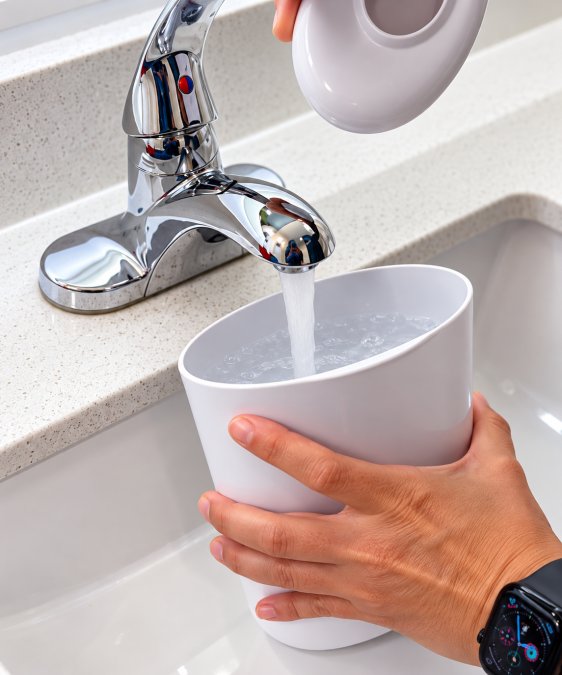
Maintaining a consistent routine with these bathroom essentials often highlights the underlying differences in the quality of paper products that influence your overall comfort.
- Charge the pump. Plug in via USB-C until the indicator shows full. A partial charge works, but you'll refill sooner.
- Fill the reservoir. Use cool or lukewarm water.
- Attach the wand. Snap the tubing onto the pump until it clicks. No tools needed.
- Set your spray mode. Start on the gentlest setting for your first use.
- Position and spray. Angle the nozzle from front to back. This keeps bacteria away from the urethra.
- Pat dry. Use a small towel or a few squares of paper.
- Empty and air-dry. Dump leftover water and let the parts dry open.
If you've never used a bidet, expect a two- or three-use learning curve. Most people adjust faster than they think.
Portable Bidet Water Capacity, Battery Life, and Spray Strength
Capacity and battery life decide how often you refill and recharge, and those two numbers matter more than any spec-sheet claim. Competitors list tank sizes and call it a day. Here is how to actually read the numbers.
Water capacity: convert it to uses, not liters
Reservoir sizes on portable units generally run from about 300 mL for a slim squeeze bottle up to roughly 1.5 L for a tank-style travel unit. The number that matters is how many washes that buys you.
A typical single wash uses somewhere in the range of 150-300 mL, depending on how long you spray and which pressure mode you pick. Do the division:
- 300 mL bottle: roughly 1-2 washes per fill.
- 500-700 mL wand reservoir: roughly 2-4 washes per fill.
- 1.4 L tank: roughly 5-9 washes per fill, which is why tank-style units suit a full day or a multi-day trip.
Higher pressure modes drain the reservoir faster. If you plan to use the strongest setting, assume the low end of each range.
Battery life: charge time, runtime, and the mid-trip failure
Rechargeable pumps typically charge over USB-C in about 4-6 hours and deliver enough runtime for several days of normal use on a full charge, but "several days" depends entirely on how many washes you take and how long each one runs.
PortaBidets Wand – Handheld Bidet, No Plumbing Needed →
Two habits prevent the most common failure:
- Top off the night before travel. A pump that sat in a drawer for months will not be at full charge.
- Fill the water. Check the water tank before you sit down on the toilet.
Unlike a line-fed attachment, a portable unit has no infinite supply, the reservoir and the battery are your limits, and both are finite by design.
Spray strength: what actually drives it
Spray strength is where cheap units fall apart, and it comes down to the mechanism:
- Squeeze bottles generate pressure from your hand. Output is strongest on the first squeeze and fades steadily as the bottle empties, because there is less water and less air to compress.
- Manual pump wands use a hand pump or bulb to pressurize the reservoir. Pressure holds steadier than a squeeze bottle, but you re-pump as the tank drains.
- Rechargeable motorized pumps hold output from the first spray to the last because the motor maintains pressure regardless of water level. This is the most consistent option and the one to pick if steady pressure matters to you.
Nozzle design matters too. A single focused nozzle gives a stronger stream; a multi-hole or oscillating nozzle spreads the same pressure across a wider area, which feels gentler but less forceful.
Comparing the two form factors
Feature |
Handheld wand + pump |
Tank-style travel unit |
|---|---|---|
Water capacity |
Reservoir-based, typically 300-700 mL |
Around 1.4 L |
Power source |
Rechargeable pump |
Rechargeable |
Approx. washes per fill |
2-4 |
5-9 |
Spray modes |
Steady pump pressure |
Multiple pressure modes and wash types |
Mounts to toilet |
No |
Yes |
Best for |
Travel, small spaces, tight bathrooms |
Hotel stays, RVs, guest baths, full-day use |
Bidet for Renters: Lease-Safe Setup and Damage-Free Removal
A bidet for renters has to leave zero trace. That rules out anything that touches the water supply line or requires drilling.
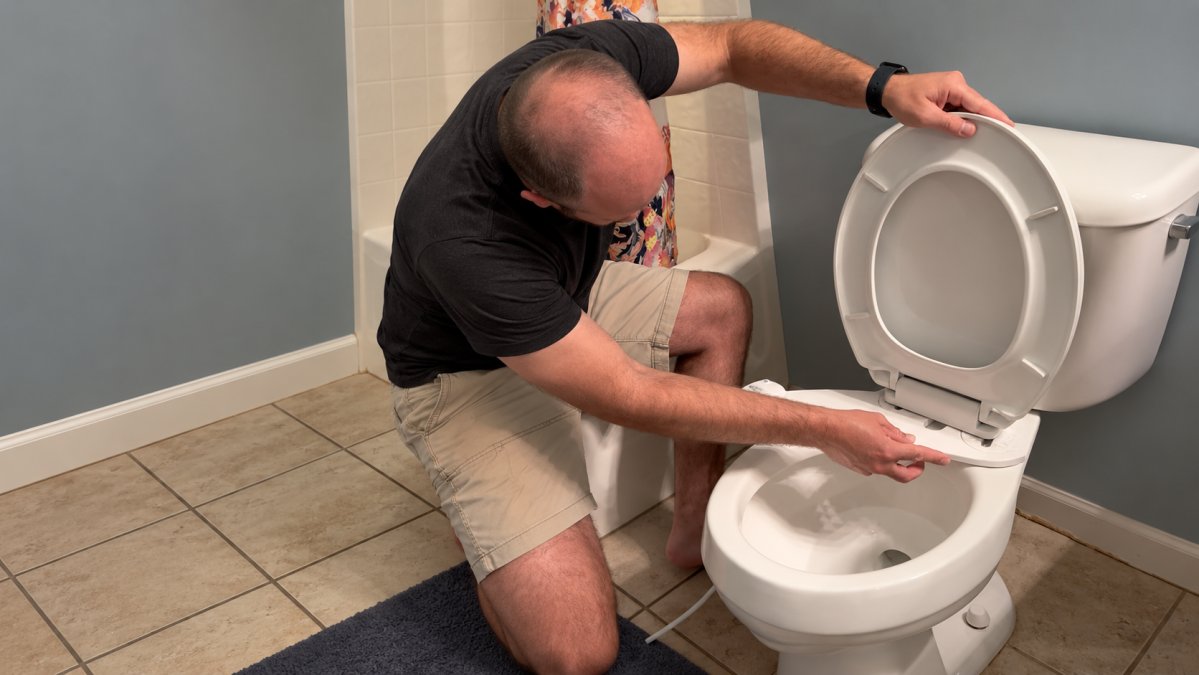
Home Bidet Attachment by PortaBidets
Most leases ban "permanent modifications." A tank adapter counts as one in many buildings, even though it's reversible. A plumbing-free unit doesn't, because it never connects to anything.
Our HUD guidance on tenant rights and lease terms explains how lease language varies by state, so read your own agreement before assuming.
For damage-free removal:
- Never use adhesive mounts on painted walls
- Wipe the seat rim after each use
- Store the unit dry between trips
- Check the reservoir seal monthly for wear
Our PortaBidets Home Bidet, No Plumbing Needed never touches the water line, so there's nothing for a landlord to flag at move-out.
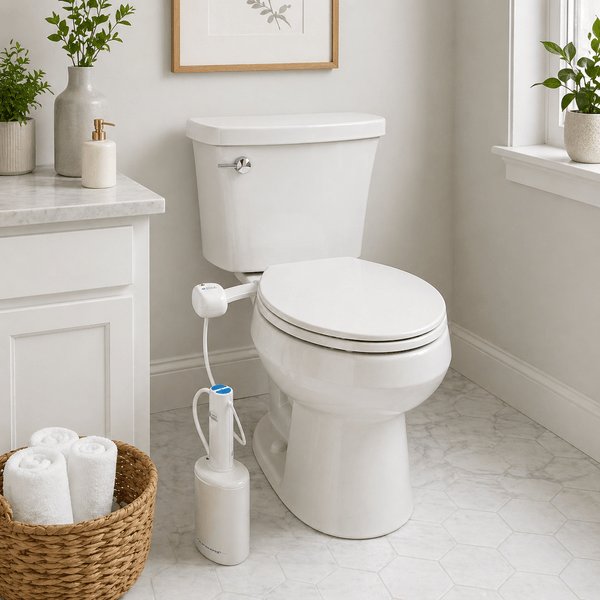
PortaBidets Home- No Plumbing Bidet
Common Mistakes and Maintenance for No-Plumbing Bidets
Most problems trace back to three habits: overfilling, skipping drying, and ignoring the nozzle.
Overfilling a reservoir causes leaks around the cap. Fill to the marked line, not past it. Skipping the dry-out step lets mildew grow inside the tubing, which is why a musty smell shows up after a few weeks in storage.
For nozzle care:
- Wipe the nozzle with a soft cloth weekly
- Descale with a vinegar soak every few months
- Replace tubing if it stiffens or cracks
On compatibility: rim-mounted units fit most standard toilets, but odd-shaped or one-piece bowls can be tight. Our Handheld Wand Add-On solves that, because the 60-inch tubing lets you spray from any angle instead of clipping to the rim.
Conclusion
The real challenge with a bidet without plumbing is finding one.
That's the problem we set out to solve at PortaBidets. Our Home bidet uses the same water pump and tank that our entire line uses with a typical bidet attachment. Our The Traveler Portable Bidet mounts to the toilet with a 1.4L reservoir and four pressure modes. The Wand pairs with a rechargeable pump for steady, handheld pressure anywhere. All install in minutes with no tools and no water line.

Get started with PortaBidets and bring real bidet comfort to any bathroom you walk into.
Frequently Asked Questions
Can you install a bidet without a plumber?
Yes. A bidet without plumbing skips the water line entirely, so no plumber is needed. Portable models use a refillable reservoir or pump that you fill at the sink, then mount or hold at the toilet. Setup takes about 10 to 15 minutes with no tools. The PortaBidets Home, for example, pairs with a pump and reservoir and requires no installation at all.
How does a portable bidet work without a water connection?
A portable bidet stores water in its own reservoir instead of pulling from your toilet's supply line. You fill the tank, then a rechargeable pump pushes water through the nozzle at pressure. The Traveler holds 1.4 liters and offers four pressure modes. No plumbing, no backflow device, and nothing connected to the toilet tank.
Can renters use a bidet without changing the toilet plumbing?
Renters don’t have to give up having a real bidet at home. The PortaBidets Home Bidet installs under a standard toilet seat without connecting to your toilet’s plumbing or water line. Its rechargeable pump and refillable water reservoir provide bidet pressure without permanent plumbing changes. When it’s time to move, simply remove the bidet and reinstall the toilet seat—no altered water lines or plumbing left behind. Always check your lease before installing any toilet accessory.
How do you refill and clean a portable bidet?
Refill by unsnapping the reservoir and filling it at any sink, then reattach it to the pump. For cleaning, rinse the reservoir and nozzle with warm water after each trip, and wipe the nozzle with a mild soap solution weekly. The Wand attachment unsnaps into two pieces so it fits inside the reservoir for storage, which also keeps the nozzle covered between uses.


